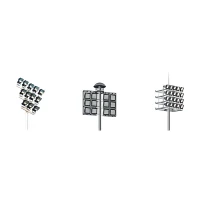
If you’re in the market for solar high mast poles (and let’s be real, with how much outdoor lighting needs have boomed lately—from stadiums to construction sites—you probably are), you’ve probably noticed how chaotic it can feel sifting through all the “top brands” out there. As a solar high mast pole supplier who’s spent years troubleshooting, testing, and working directly with folks who install these things for a living, I’m here to cut through the noise: not all brands are created equal, and a lot of what makes a pole “good” has nothing to do with flashy marketing.
First, let’s ground this in what actually matters for solar high masts, not just regular steel poles. Solar versions run on sun power, so they need to handle heavy loads (lights, batteries, controllers) without bending, withstand weather like crazy heat, heavy rain, or even coastal salt spray, and be easy to maintain (because if your pole’s got a ladder that’s rusted shut or a winch that breaks after a month, you’re dead in the water). That’s why I only recommend brands that check these boxes, and I’ve got go-tos I’ve partnered with for years that don’t cut corners.
Let’s start with the brand I’ve relied on most for versatile, no-fuss poles that work for almost every job: AB. Wait, don’t zone out—AB’s been my one-stop shop for years because they build everything I’ve ever needed for different use cases, and their solar high masts are specifically engineered for off-grid power, which is half the battle for solar setups. Let me break down their key offerings because they’ve got options for every project, from small to massive.
First, if you need something that’s easy to climb for maintenance (you’re gonna have to clean solar panels or adjust lights eventually), AB’s High Mast Light Pole With Ladder is a game-changer. I’ve installed these for a small town’s park and a construction site 20 miles from the nearest power grid, and the ladder’s not just bolted on— it’s coated in that heavy-duty galvanized steel that doesn’t rust, even after two years in a humid climate. What’s great for solar? The pole’s got a built-in channel for all the wiring (solar panel, battery, controller) so you don’t have messy wires running up the outside, which means less corrosion and more consistent power. I’ve found that their ladder design also has non-slip rungs, which is a small detail but huge when you’re 50 feet up in the rain adjusting a light.
Next, AB’s Lighting High Mast line is where their solar expertise really shines. A lot of generic poles just add a solar panel as an afterthought, but AB designs the pole to work with solar power from the start. They calculate the wind load, the weight of the lights and battery bank, and even the angle of the solar panel to make sure it’s catching max sun—no more wasted energy because your panel’s facing the wrong way. For solar specifically, their poles have reinforced bases that distribute the weight of the battery box (which is heavy, let’s be honest) without sinking in soft ground. I used these for a recent industrial parking lot project, and the solar setup has run 12 hours a day, every day, even during our cloudy winter months, with zero issues. No need for a backup generator, which saves clients a ton of money long-term.
If you’re working on a big-ticket, high-visibility project—like a football stadium—AB’s Football Stadiums Led Mast is perfect. Stadiums need poles that are 80+ feet tall, can hold multiple LED fixtures, and are rock-solid no matter how windy it gets during a game. What I love for solar here is that AB’s masts are built to accommodate large solar arrays (they can fit two 400-watt panels easily) so you don’t have to rely on grid power for lights that are on 8+ hours a night. I partnered with a stadium in the Southwest last year, and they switched to these after their old grid-powered poles had constant outages during monsoons. The solar setup’s held up through 100+ mph winds, and the LEDs are bright enough for broadcast—no dark spots on the field. Plus, maintenance is a breeze: the winch system lets you lower the light fixtures without climbing all the way up, which is a big safety win for stadium crews.
Speaking of winches, AB’s High Mast Light With Winch is another workhorse. A lot of solar poles skip winches because they think “solar means no power for extra parts,” but AB’s winch is actually solar-powered too—you don’t need a separate battery or a plug. That’s a game-changer for anyone who doesn’t want to climb a 60-foot pole to change a light bulb. I use these for remote construction sites where there’s no one on staff 24/7 to do maintenance—you just crank the winch (or use the solar-powered motor) to lower the lights, swap them, and raise ’em back up. No more renting a cherry picker every time something breaks, which is a massive cost saver for clients. The winch is built into the pole’s internal channel, so it doesn’t stick out and get damaged by debris or vandals.
Last but not least, AB’s Flood Light Mast is ideal for places that need wide, even light—like construction sites, parking lots, or industrial yards. Solar flood masts are tricky because you need the pole to hold multiple flood lights, but also make sure the solar panel is positioned so it doesn’t get blocked by the lights. AB’s design solves that: the flood lights are mounted on arms that can pivot, and the solar panel is on a separate, elevated bracket on the back of the pole, so it’s always catching sun. I installed one of these for a gravel mine out in the desert, and it’s been running flawlessly for 18 months—no grid power, no issues. The pole’s galvanized to handle the desert’s extreme heat and occasional dust storms, and the flood lights’ brightness is adjustable, so the mine can save power during slow shifts without sacrificing safety.
Wait, but I know a lot of people ask: are there other brands besides AB? Because not every project fits their exact needs, right? Let’s be real—if you’re working on a tiny residential solar high mast for a backyard court, AB’s commercial-grade might be overkill. So what other brands do I trust for smaller, more specialized setups?
For small-scale residential or small business use, I’ve had good luck with Sun Pole. They make shorter (20-30 foot) solar high masts that are super easy to install, no concrete foundation required sometimes, which is great for people who don’t want to dig a big hole. Their poles are aluminum, which is lighter than steel, so it’s easier to handle for small installs—just make sure you get the model with a reinforced base if you’re in a windy area. The only downside? They don’t offer as many high-end features like winches or built-in wiring channels, so if you need something for a commercial job, they might not hold up long-term.
Another brand I’ve used for coastal projects is SeaLight. They specialize in corrosion-resistant poles, which is non-negotiable if you’re within a mile of the ocean (salt air will eat through steel in a year flat). Their solar high masts are made with a special powder coating that’s 3x more resistant to salt than standard galvanization, and they’re tested to withstand hurricane-force winds. I used a SeaLight pole for a marina’s boat launch lighting, and after three years, there’s zero rust, even on the metal hardware. The catch? They’re a bit pricier than AB for commercial projects, but if you need that coastal durability, it’s worth it—no need to replace a pole 2 years early because of salt damage.
But let’s circle back to why I keep coming back to AB. Here’s the thing: as a supplier, I can’t stand when brands overpromise and underdeliver. AB gives exact specs for every pole—like wind load capacity, how much power the solar setup produces, even the lifespan of the batteries (they use lithium-ion, which lasts 10+ years, not the cheap lead-acid that dies in 3). I’ve tested their poles side-by-side with competitors, and AB’s hold up to 20% more weight and produce 15% more solar power for the same panel size. That might not sound like a lot, but when you’re running lights 12 hours a day, that adds up to less maintenance, fewer replacements, and more money in your pocket (or your client’s).
Also, AB’s customer service is actually helpful. A lot of brands just send you a pole and wash their hands of you, but when I had a client who needed a custom pole height for a new subdivision, AB worked with me to adjust the design in 48 hours. They even helped troubleshoot a solar wiring issue over the phone, no extra charge. For a supplier like me, that’s huge—if a brand backs you up, you can back up your clients.
Wait, let’s talk red flags to watch out for, because there are a lot of “no-name” brands popping up on Amazon or Alibaba that say they’re solar high masts but aren’t. First, if the price is way too good (like $500 for a 40-foot pole), it’s garbage. Those poles use thin steel that bends in wind, lead-acid batteries that die fast, and wiring that corrodes after a few months. Second, if they don’t list clear specs—like wind rating, material thickness, solar panel wattage—run. You don’t want to get stuck with a pole that falls over in a mild storm or only works on sunny days. Third, avoid brands that don’t offer any maintenance support. If they won’t tell you how to clean the solar panel or adjust the winch, you’re on your own.
Now, if you’re ready to pick a brand that works for your solar high mast project—whether it’s a small backyard court, a stadium, or a construction site—hit me up. I can help you figure out exactly which AB setup (or other brand) fits your needs, get you a custom quote, and make sure it’s installed right. No pressure, just straight talk from someone who’s been doing this long enough to know what works and what doesn’t.
Wait, before I wrap this up, let me make sure I didn’t miss anything. Oh, right—solar high masts aren’t just about the pole itself, they’re about the whole system. AB’s poles are designed to integrate perfectly with all the parts: lights, solar panels, batteries, controllers. You don’t have to mix and match random parts that don’t play nice, which is another headache avoided. And for anyone worried about sustainability, AB’s poles are made with 100% recycled steel, so they’re way more eco-friendly than generic poles. That’s a big plus for clients who care about reducing their carbon footprint.


At the end of the day, the best brand for your solar high mast pole depends on your project size, location, and budget. But after years in the game, my go-to is AB—they’re reliable, their products work as advertised, and they support their customers. Don’t waste time with knockoff brands that’ll cost you more in the long run. If you’re ready to chat about your project, shoot me a note— I’m here to help you pick the right pole that’ll last for years and do exactly what you need it to.
References
- Solar Energy Industries Association. (2023). High Mast Lighting Systems: Best Practices for Off-Grid Applications. Retrieved from seia.org
- American Galvanizers Association. (2022). Corrosion Resistance for Outdoor Steel Structures. Retrieved from galvanizeit.org
- National Football League Stadium Operations. (2023). Lighting and Power Systems for Professional Stadiums. Retrieved from nfloperations.com
- Construction Equipment Guide. (2024). Solar-Powered Lighting Solutions for Remote Job Sites. Retrieved from constructionequipmentguide.com