


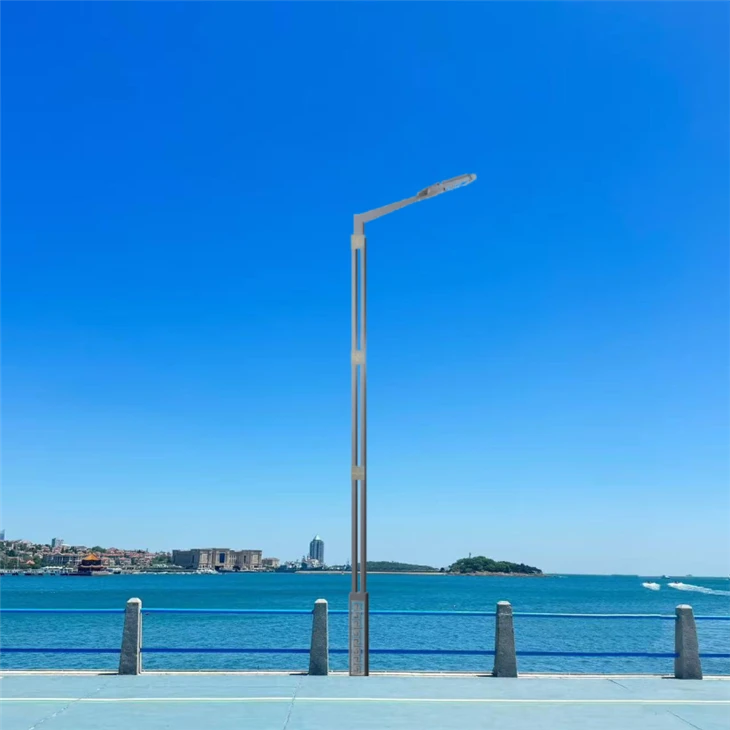
Product Introduction
◎Advantages of monocrystalline silicon cells: Due to their complete atomic arrangement and few grain boundary defects, monocrystalline silicon cells are significantly superior to polycrystalline silicon in terms of photoelectric conversion efficiency, temperature coefficient, low-light response, and full-life-cycle economy. The laboratory efficiency reaches 26.81%, and the commercial efficiency ranges from 21% to 23%. The 25-year power generation revenue is 12%-15% higher than that of polycrystalline silicon.
◎Architecture of intelligent monitoring system: Adopting a three-layer "terminal-edge-cloud" architecture, integrating LoRa/PLC communication, AI fault diagnosis model, and GIS positioning function, it realizes fault location within 30 seconds, 5m-level precision alarm, and automatic generation of operation and maintenance work orders.
◎Energy consumption optimization strategies: Through time control + light control + pedestrian flow sensing dimming (brightness dynamically adjusted in the range of 30%-100%), seasonal strategies (brightness reduced by 50% in the second half of summer nights), and snowfall compensation (brightness increased by 20% when snow accumulation exceeds 10cm), the comprehensive power saving rate reaches 42%-58%.
◎Predictive maintenance technology: Based on abnormal current/voltage detection, battery internal resistance analysis, and LED light decay model, it warns of component failures 3 months in advance. Combined with digital twin simulation, it optimizes lighting parameters (such as shortening the distance between street lights to 25m in the Qinghai project).
◎Typical scenario applications: The Qinghai photovoltaic highway project uses monocrystalline silicon + snow sensors to achieve efficient power generation in alpine environments. The Singapore smart park verifies the technical adaptability and the effect of reducing operation and maintenance costs by 40%-65% through 5G network association with security systems.

Monocrystalline Silicon Cells
Material Properties and Manufacturing Process
Monocrystalline silicon cells use the Czochralski method to grow monocrystalline silicon ingots, whose atoms are arranged in a continuous and complete cubic lattice structure with a grain boundary defect density of less than 10⁴ cm⁻². This structure endows it with three core advantages:
◎High carrier mobility: Electron mobility reaches more than 1500 cm²/V·s, nearly double that of polycrystalline silicon (500-800 cm²/V·s), significantly reducing resistance loss.
◎Low recombination loss: Weak grain boundary scattering effect, minority carrier lifetime exceeds 10μs, surface recombination rate is less than 100 cm/s, and photocurrent collection efficiency is increased by 30%.
◎High tolerance: Resistance to potential induced degradation (PID) reaches more than 95%, and the power attenuation rate is less than 0.3% under -1000V bias voltage for 24 hours, far better than 3%-5% of polycrystalline silicon.

Power Generation Efficiency and Environmental Adaptability
◎High-temperature performance: The temperature coefficient of monocrystalline silicon cells is -0.38%/℃, and the power attenuation rate is less than 0.5%/℃ at 85℃ working temperature; the temperature coefficient of polycrystalline silicon cells is -0.42%/℃, and the attenuation rate is 10%-15% higher under the same conditions. Taking Dubai summer as an example, the annual power generation of monocrystalline silicon modules is 8%-12% higher than that of polycrystalline silicon.
◎Low-light efficiency: Under low irradiance of 200 W/m², monocrystalline silicon cells can still maintain more than 85% of the nominal efficiency, while polycrystalline silicon cells' efficiency drops to 75%-80%. This feature gives it significant advantages in cloudy weather or high-latitude areas (such as Northern Europe).
Performance Comparison Table of Monocrystalline Silicon and Polycrystalline Silicon
|
Parameter |
Monocrystalline Silicon |
Polycrystalline Silicon |
|
Photoelectric Conversion Efficiency |
21%-23% (26.81% in laboratory) |
16%-19% (20.4% in laboratory) |
|
Temperature Coefficient |
-0.38%/℃ |
-0.42%/℃ |
|
Low-Light Efficiency (200W/m²) |
≥85% |
75%-80% |
|
First-Year Attenuation Rate |
≤2.5% |
≤3% |
|
25-Year Attenuation Rate |
≤15.5% |
≤22.1% |
|
PID Resistance |
95%+ |
75%-85% |
|
Power Generation per Unit Area |
Benchmark (100%) |
85%-90% |
|
Typical Application Scenarios |
Roof power stations, high-latitude areas, smart street lights |
Ground power stations, agricultural photovoltaics, cost-sensitive projects |
Intelligent Monitoring System
1.System Architecture and Core Technologies
Modern LED solar integrated street lights adopt a three-layer architecture:
◎Terminal layer: Integrates a single-lamp controller (supporting 0-10V/PWM dimming), current sensor (accuracy ±0.5%), voltage sensor (accuracy ±0.2%), and environmental monitoring module (illumination, temperature, humidity).
◎Edge layer: Deploys an AI computing box (with 4TOPS computing power) to run a lightweight fault diagnosis model (based on LSTM neural network) for localized real-time decision-making.
◎Cloud platform layer: Provides device management, strategy issuance, data analysis, and visualization functions, supporting GIS map positioning of fault points (accuracy ≤5m) and generating operation and maintenance work orders.
2.Core Function Modules
Fault early warning and positioning:
◎Abnormal current detection: When the starting current exceeds 20% of the rated value or the working current fluctuates by more than ±15%, the system locates the faulty lamp within 30 seconds and pushes alarm information through the APP (including device ID, location, and fault type).
◎Voltage deviation analysis: Real-time monitoring of battery voltage (range 10.8-14.4V). When the voltage is continuously lower than 12V for more than 1 hour, it automatically triggers battery health assessment (based on internal resistance measurement).

3.Energy consumption optimization strategies:
◎Time control + light control linkage: Automatically calculates sunrise and sunset times according to latitude and longitude, and dynamically adjusts brightness in combination with real-time illumination intensity (detected by a photoresistor). For example, street lights in Beijing are automatically turned on at 5 pm in winter, and the brightness is gradually increased to 100% as the ambient light fades.
◎Pedestrian flow sensing dimming: Integrates a microwave radar sensor (detection range 8-12m, angle 120°). When pedestrians or vehicles are detected, the brightness of the street light is increased from 30% to 80%, and returns to low-brightness mode 30 seconds after people and vehicles leave. After applying this strategy in the Hangzhou Xixi Wetland project, nighttime energy consumption was reduced by 58%.
◎Seasonal strategies: Adopts the "post-midnight dimming" mode in summer (brightness reduced to 50% after 1 am), and maintains full-power operation throughout the night in winter, with an annual comprehensive power saving rate of 42%.
Product Advantages
◎Monocrystalline silicon cells
◎Intelligent monitoring system
◎Fault early warning
◎Energy consumption optimization
◎Predictive maintenance
◎Photoelectric conversion efficiency
About Us
|
Address: |
Guoji Industrial Park, Songqiao Town, Gaoyou City, Jiangsu Province, China ; |
|
Tel/WhatsApp: |
+86 18118266199; |
|
Mail: |
hjy@jcledzm.cn |
Hot Tags: led solar integrated lamp, China led solar integrated lamp manufacturers, suppliers, factory, All in Two Solar Street Light, Led Lamp Street Light, Led Lens Street Light, Led Lights Road, Motion Sensor Solar Street Light, Solar Led Light 100w


